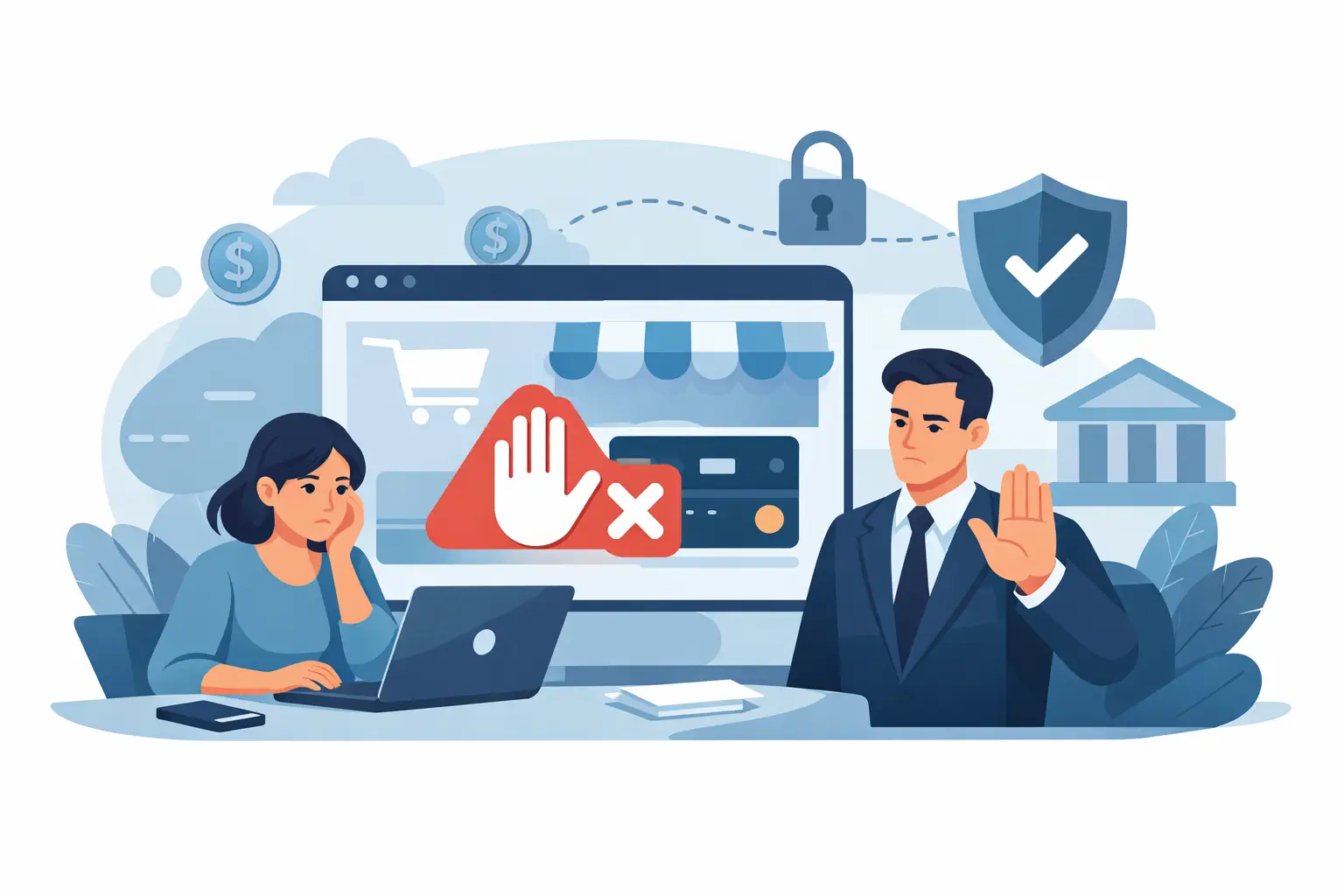
A rejected merchant account can stop revenue before your checkout ever has a chance to perform. For founders who have invested in a website, inventory, ads, and subscriptions, the question is urgent: why processors reject online businesses when the business itself is legitimate and ready to sell?
The short answer is risk. But that word is often used as a catch-all instead of an explanation. Payment processors are not only evaluating whether your business can take card payments. They are estimating whether your transactions could lead to chargebacks, fraud losses, regulatory trouble, customer disputes, or sudden account instability.
For many online merchants, especially those selling subscriptions, digital products, higher-ticket offers, or products in restricted categories, a standard processor is built to say no quickly. Understanding what triggers that decision gives you a better path to approval and a more stable payment operation.
Why Processors Reject Online Businesses at Application
Underwriting begins before the first payment is accepted. A processor reviews the information in your application, your website, your products, your expected sales volume, and often the owners behind the company. The goal is not to judge your business concept. The goal is to determine whether the processor can support the account without taking on more exposure than its policies allow.
A new business with no processing history is not automatically a problem. But a new business with unclear offers, aggressive sales claims, missing policies, and an industry that historically produces disputes will raise immediate concerns. When those signals stack up, an automated approval flow may reject the application without giving you a useful explanation.
This is why merchants should not treat payment processing as a last-minute website task. Your processor sees your checkout as part of a larger risk picture: how customers are acquired, what they are promised, how fulfillment works, and whether the business can absorb refunds or disputes.
Your industry falls outside the processor’s appetite
Every processor has an acceptable risk profile. Many conventional providers prefer low-ticket retail, established service businesses, and straightforward physical goods. They may restrict or decline categories such as subscription programs, supplements, adult-oriented products, digital goods, online coaching, continuity offers, CBD-related products, travel, firearms accessories, debt-related services, and other sectors with elevated dispute or compliance exposure.
That does not mean the business is unlawful or unworthy of payment acceptance. It means the processor does not have the banking relationships, underwriting policies, or risk controls to support that category comfortably.
A specialized high-risk payment provider evaluates the same business differently. The question becomes whether your operation has the right disclosures, delivery process, fraud controls, and transaction structure to process responsibly. That is a far more useful conversation than a generic decline.
Your website does not answer the underwriter’s questions
A polished design helps, but underwriting is looking for operational proof. Your site should make it obvious what you sell, how much it costs, when customers receive it, and how they can request support or a refund.
Missing contact information, incomplete legal pages, vague product descriptions, broken checkout links, or unsupported income and health claims can all create problems. So can a website that appears unfinished or does not match the business description on the application.
For recurring billing, the requirements are even stricter. Customers must be told clearly that they are enrolling in ongoing charges, the billing amount and frequency, and how to cancel. Hiding those details may improve a short-term conversion metric, but it can create a chargeback problem that threatens the entire merchant account.
The transaction profile looks difficult to support
Processors look at how money moves through your business. Large average tickets, high projected monthly volume, delayed fulfillment, international sales, card-not-present transactions, and recurring payments each add exposure. None is automatically disqualifying. Together, they require a provider that understands how to underwrite and monitor that profile.
For example, a merchant selling a $39 physical product with three-day fulfillment creates a very different risk profile from a business charging $1,500 for a digital program delivered over six months. The second merchant may be fully legitimate, but customers have more time to dispute the charge, and the processor may remain exposed long after the original transaction.
Be accurate about projections. Understating expected volume to get approved can backfire when real sales exceed the approved profile. A sudden jump in volume can trigger reviews, payout delays, or account restrictions because it resembles fraud or an unreported change in business activity.
The Risks That Matter After Approval
Approval is not the finish line. Online businesses can also lose processing access after onboarding if their operating behavior does not match the account profile or if their dispute activity rises too high.
The most common issue is chargebacks. A chargeback tells the card issuer that the customer believes a transaction was unauthorized, not delivered, misrepresented, or improperly billed. Even when a merchant wins some disputes, a rising chargeback rate signals that something in the customer experience needs attention.
Chargebacks rarely have one cause. They may come from unclear billing descriptors, slow customer support, delayed shipping, confusing cancellation processes, weak fraud screening, or marketing that promises more than the offer delivers. Treat them as operational feedback, not just a cost of doing business.
Fraud is another major concern. Online checkout does not provide the same identity signals as an in-person card transaction. Fraudsters test stolen cards, place high-value orders, exploit digital delivery, and target merchants whose controls are too loose. A processor that sees repeated suspicious activity may protect itself by pausing payouts or closing the account.
This is where the trade-off matters. Tighter fraud rules can block some legitimate buyers, particularly if you sell internationally or to customers using privacy tools. Loose rules can create losses and account instability. The right setup balances conversion with controls appropriate for your product, price point, customer base, and fulfillment model.
How to Make Your Business Easier to Approve
The best applications reduce uncertainty. Underwriters do not need a perfect business with years of history. They need a clear, consistent account of what you sell and how you manage customer expectations.
Start by aligning your business information everywhere. Your legal business name, website domain, customer support details, product descriptions, and application should tell the same story. If you use a DBA, make that relationship clear. If you have prior processing statements, provide them when requested. Strong history can demonstrate that your sales volume and dispute levels are manageable.
Build the customer-facing basics before submitting an application. Your site should include visible contact methods, clear pricing, shipping or delivery terms, a refund policy, privacy policy, and terms of service. Subscription merchants should place recurring billing disclosures near the checkout decision, not bury them in a footer.
You should also be prepared to explain four areas in plain language:
- What you sell and who buys it
- How and when customers receive their product or service
- How customers cancel, return, or request a refund
- What sales volume, average ticket, and billing frequency you expect
These details help a high-risk specialist structure an account around your actual needs. They also prevent the operational mismatch that causes trouble later.
Choose a processor that fits your model
The cheapest advertised processing rate is not always the lowest-cost decision. A provider that cannot support your category may approve you initially, then impose a reserve, delay funds, or terminate the account after growth begins. That disruption can cost more than a transparent high-risk solution designed for your business from day one.
Ask direct questions before onboarding. Will there be a rolling reserve? How often are payouts sent? Can you access transaction data and dispute information from one dashboard? Does the gateway work with your WordPress store, subscription platform, or virtual terminal workflow? Who helps when underwriting requests additional documentation?
Merchants need answers, not vague assurances. Processing is revenue infrastructure. If your business relies on online payments, you need visibility into transactions, clear expectations around funding, and support that understands your sales model.
Build for Stable Processing, Not Just Fast Approval
A fast approval is valuable, but a stable account is more valuable. Keep your website current, respond quickly to support requests, monitor disputes weekly, and notify your processor before major changes in product lines, pricing, fulfillment timelines, or volume. Surprises create risk reviews. Proactive communication builds confidence.
Myco Solutions works with merchants who need a payment environment built for real online business complexity, including gateway setup, recurring billing, virtual terminals, and practical access to transaction data. The right fit is not about forcing your business into a low-risk template. It is about putting the right controls and support behind the way you already sell.
If mainstream processors have rejected your business, use the experience to strengthen your setup rather than scaling back a legitimate opportunity. Clear offers, honest billing, reliable fulfillment, and a processor aligned with your category can turn payment acceptance from a recurring obstacle into a dependable part of growth.