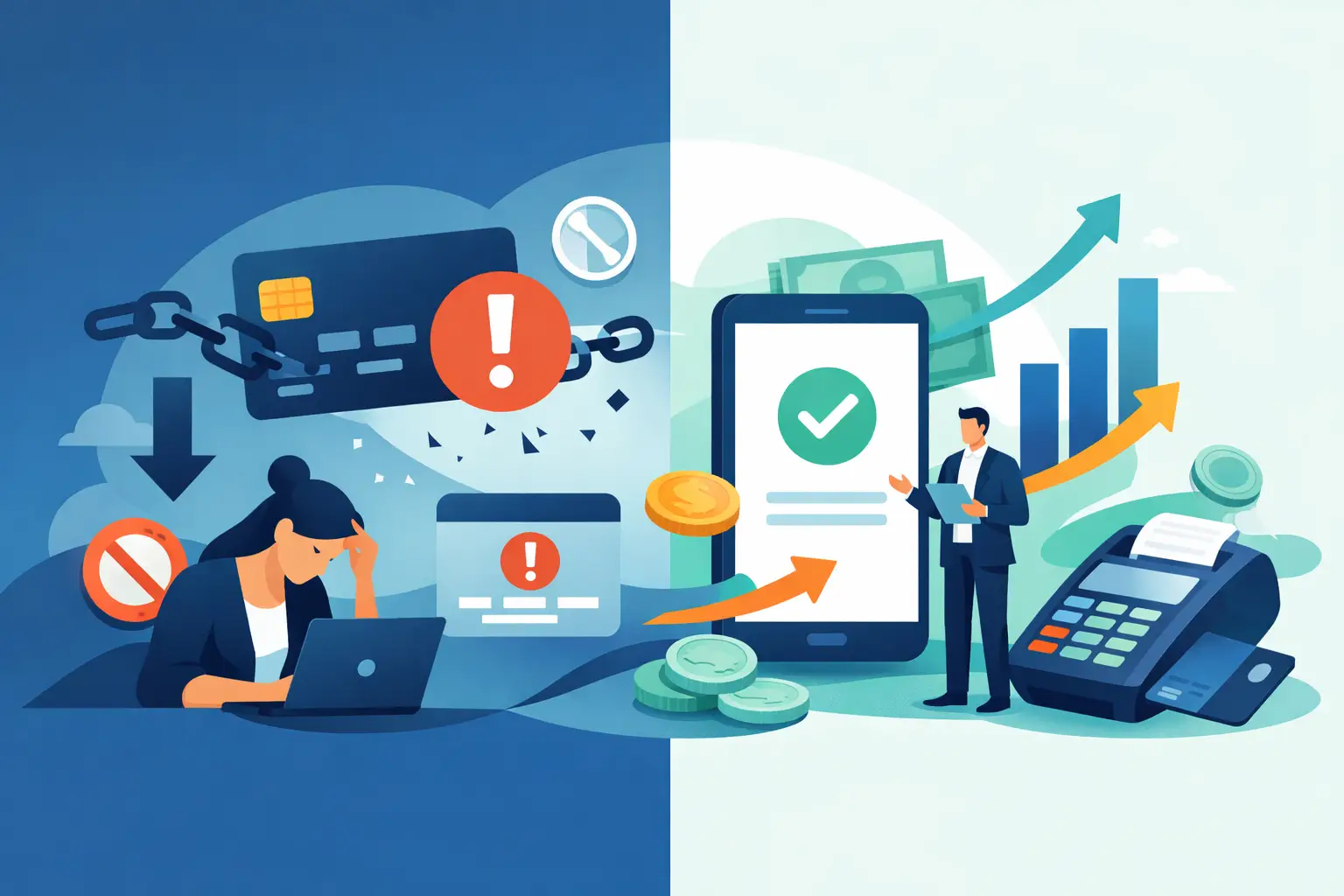
A customer reaches checkout, enters valid card details, and gets a decline message. That single moment can cost more than one order. It can mean wasted ad spend, a lost subscriber, a support request, or a customer who never returns. Understanding why payments fail gives online merchants the control to fix avoidable issues and route legitimate sales through a payment environment built for their business.
For high-risk merchants, a decline is rarely just a card problem. It can involve the issuing bank, fraud filters, your gateway settings, subscription logic, transaction data, or the way your business is categorized. The goal is not to force every transaction through. The goal is to improve approval rates without creating chargeback exposure or putting your merchant account at risk.
Why Payments Fail at Checkout
A payment approval requires several systems to agree in seconds. The customer’s bank must approve the charge, the card network must pass the authorization, the gateway must send complete transaction data, and the processor must accept the transaction under your account rules. A failure at any point can produce a decline.
Some declines are legitimate and cannot be fixed by changing processors. A card may have insufficient funds, be expired, be reported lost, or be blocked by the bank because the customer has reached a spending limit. Those are customer-level issues.
Other declines point to a merchant-side opportunity. If a gateway sends incomplete billing details, if fraud rules are overly aggressive, or if recurring billing is not configured correctly, good customers can be turned away. That is where the right payment setup makes a measurable difference.
Issuer Declines and Bank Controls
The customer’s issuing bank has the final decision on many card transactions. Banks use real-time risk models that consider spending patterns, account history, location, merchant type, purchase amount, and prior disputes. A customer who has made a $30 purchase from your store may be approved, while the same customer’s $300 order triggers a security review.
High-risk categories face extra scrutiny because banks may apply tighter rules to certain products, recurring offers, or digital delivery models. That does not mean the transaction is bad. It means the authorization needs clean data and a processing relationship designed to support the business model.
When issuer declines rise suddenly, look for patterns. Are they tied to a specific card type, order value, state, offer, or time of day? A dashboard with transaction-level visibility helps separate ordinary insufficient-funds declines from a broader approval problem.
Fraud Filters That Block Good Customers
Fraud prevention is necessary, but excessive filtering can quietly cut revenue. Common triggers include an address mismatch, a CVV mismatch, an IP address outside the billing region, multiple attempted purchases, or an order that exceeds your normal ticket size.
The trade-off is real. Looser rules may increase approvals but can expose the business to fraud and chargebacks. Tighter rules may reduce fraud but reject customers who would have completed a legitimate purchase. The answer is not to turn every filter off. It is to set rules based on your actual risk profile, customer behavior, and product type.
For example, an international IP address may be a serious concern for a local service business, but it may be normal for a digital product sold globally. A subscription merchant may need to allow a reasonable number of retry attempts, while a one-time high-ticket seller may prefer manual review for certain orders.
Incorrect or Incomplete Transaction Data
Small technical details can affect whether a payment reaches the issuer correctly. Incorrect merchant descriptors, missing billing fields, improperly formatted addresses, and outdated gateway integrations all create unnecessary friction.
The checkout experience matters too. If a form does not clearly identify required fields or fails on mobile devices, customers may enter information incorrectly or abandon the transaction before authorization. WordPress stores should verify that plugin updates, theme changes, caching tools, and checkout extensions are not interfering with gateway communication.
Before blaming the customer or the bank, test your checkout from multiple devices and browsers. Confirm that authorization requests are reaching the gateway, required data is being passed, and decline codes are being recorded accurately.
Recurring Billing Creates Its Own Failure Points
Subscription revenue depends on more than the first successful charge. Cards expire, customers receive replacement cards, bank accounts change, and issuers may decline a recurring transaction even when the initial sale was approved.
A weak recurring setup treats the first decline as the end of the relationship. A stronger setup uses reasonable retry logic, clear customer notifications, and account-updater capabilities where available. The timing matters. Retrying a failed charge repeatedly in a short window can look suspicious to an issuer and frustrate the customer.
Your billing descriptor also needs to be recognizable. Customers often dispute charges because they do not recognize the name shown on their statement, not because they believe fraud occurred. Clear descriptors, accessible support, and transparent subscription terms can reduce both failed renewals and costly disputes.
Gateway and Integration Failures
Not every failed payment is a decline. Sometimes the customer sees an error because the transaction never reached the bank. Gateway outages, expired API credentials, incorrect webhook settings, SSL problems, plugin conflicts, and improperly configured payment methods can all interrupt checkout.
These failures are especially damaging because they can look like customer abandonment in your store analytics. If your checkout conversion rate drops while traffic and add-to-cart activity remain stable, investigate the payment flow immediately.
A practical operating routine includes monitoring gateway notices, testing checkout after site updates, reviewing failed transaction logs, and keeping a documented process for technical changes. Businesses that use virtual terminals should also train staff to recognize the difference between a genuine card decline and a data-entry or connectivity issue.
How to Reduce Payment Failures Without Raising Risk
Start by measuring the right reasons for failure. A generic “declined” label is not enough. Review issuer response codes, fraud-rule rejections, gateway errors, recurring billing failures, and customer abandonment separately. Each category requires a different response.
Then review your transaction data. Are AVS and CVV rules appropriate for your offer? Is your descriptor clear? Are billing and shipping fields being captured properly? Are large orders, international orders, or repeat attempts being treated consistently?
Next, match your payment infrastructure to your business model. Merchants selling in restricted or high-risk categories need more than a basic checkout button. They need a merchant account, gateway configuration, and onboarding team that understand recurring revenue, elevated dispute exposure, and the need for stable processing continuity.
Myco Solutions helps merchants build that kind of environment with specialized payment acceptance, hands-on technical setup, and the operational visibility needed to identify problems before they become lost revenue. Daily payouts and transparent transaction dashboards also give operators a clearer view of what is happening after a customer clicks pay.
When a Decline Is Actually a Warning Sign
Chasing approval rates without considering quality can create a bigger problem later. A sudden spike in approvals may look positive, but if it comes with more fraud, refund requests, or chargebacks, the business may face tighter account restrictions and higher costs.
Watch for repeated failed attempts from the same card, inconsistent billing and shipping details, unusually large orders from new customers, and clusters of transactions with similar patterns. These do not automatically mean fraud, but they deserve closer review.
The strongest payment strategy balances conversion with control. It gives real customers a clean path to pay while creating sensible barriers against transactions that could damage the business. That balance depends on your industry, average order value, fulfillment model, and customer base.
A failed payment should never be treated as a mystery or an unavoidable cost of doing business. With clear decline data, a properly configured gateway, and a processor that understands high-risk commerce, you can turn payment failures into specific actions that protect both revenue and long-term account stability.